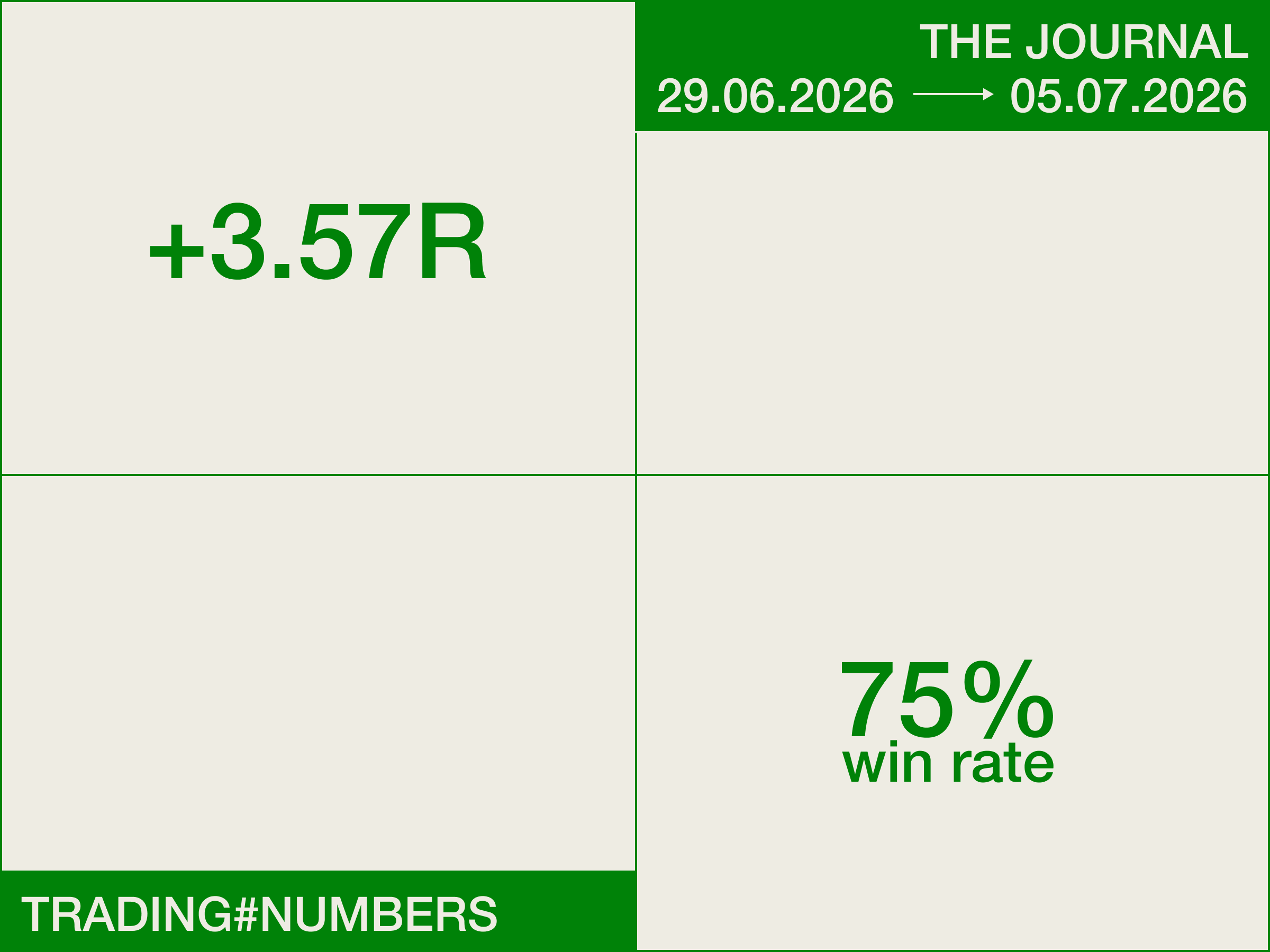
Dates
29 June 2026 to 05 July 2026
Trading Numbers
What happened
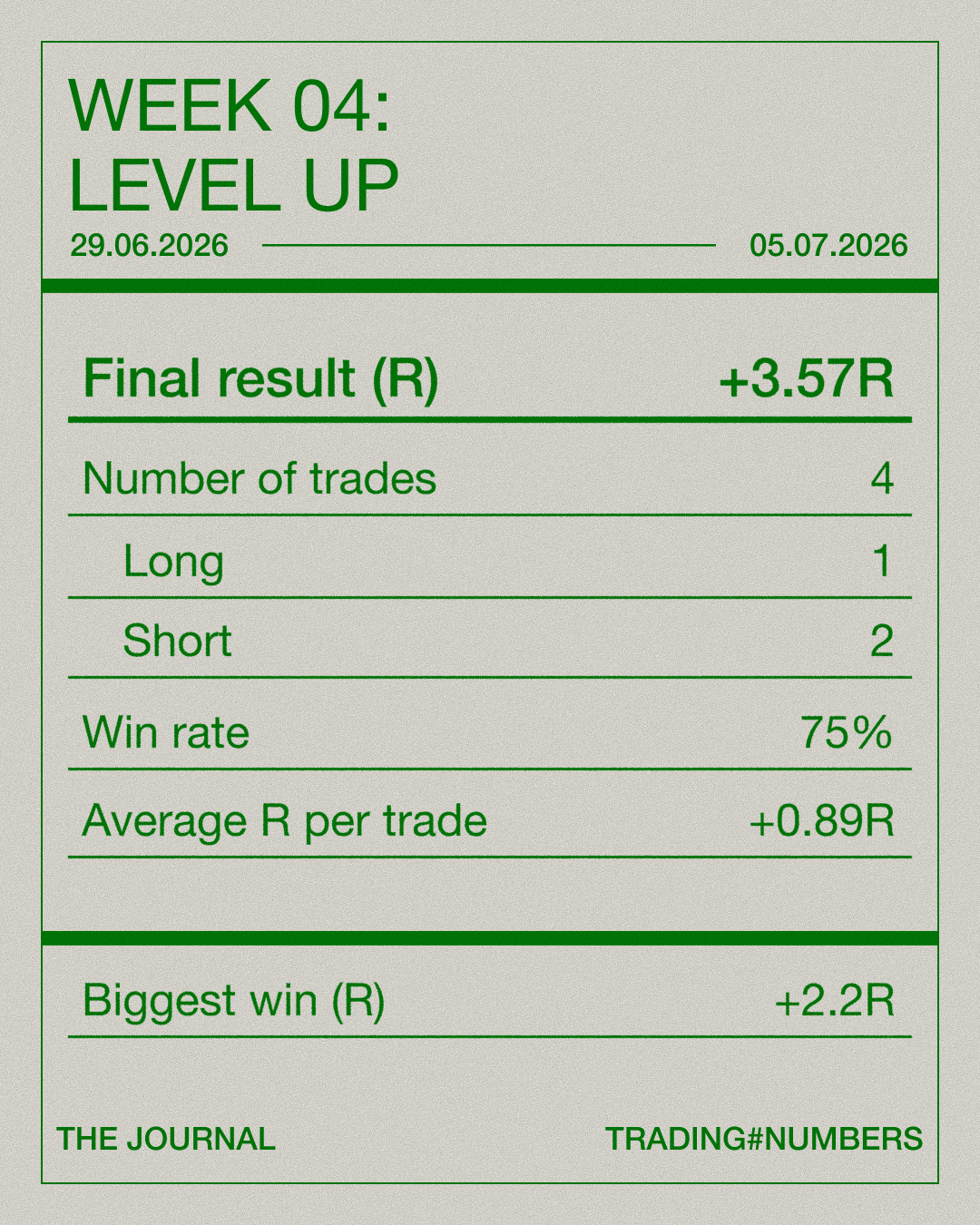
This was a good week. Possibly my best week. Not only because I ended up +3.57R, but because I was actually able to make a mistake, identify the problem, and most importantly be given the opportunity to fix it very quickly. It’s almost as if feedback works.
While, I may not have fixed everything from my previous weeks, the general mindset and process of this whole journaling exercise has become more natural and…dare I say effective?!
The lessons from this week go beyond system mechanics to more of a trading thought process and I’m glad to be able to share these ones.
Key takeaways
1. Learn from your mistakes. Like actually.
The adage about learning from your mistakes has never held truer for me than this whole week.
My journal is ultimately a way for me to collect the most meaningful data and since I started being very disciplined about it, I’ve actually learned from my mistakes.
In the past it used to go something like this: make a mistake, take a loss, mentally tell myself, “don’t do that again”, forget what the mistake was, and then…yep, make the same mistake again. And the cycle went on.
This time was different. I made a mistake on one trade and then was fortunate enough for the market to give me a fresh chance to fix that mistake on another trade the next day.
My first trade was a winner. Entry was solid and so was invalidation. Not long after entry, I watched my BTC short head close-ish to my full take profit, only to bounce back sharply. Orderflow revealed a decent amount of longs piling in so I closed for +1.6R. Minutes later, it popped down to my full TP.
I re-capped the trade in my journal noting the exit was based on fresh orderflow data. However while I wrote it all down, I knew it my heart that it was mostly an emotional exit. I didn’t want to give back what I had. Sure there was some data behind it, but the fact was, the trade and profit target were actually not invalidated. Moments after I closed, price hit my planned exit target for what could have been a +2.6R trade. I noted this, lamented it, then moved on telling myself to learn from it.
Well, the very next day, a similar set up presented itself. The exact same situation played out. This time I didn’t hesitate to stay in the trade. The previous lesson was so fresh in my mind and the price action was so similar that I just let it all be. And just like that a +2.2R was closed at my full TP target.
2. Is it worth it?
Every trade needs to be worth it.
For the two set ups in my system, my profit targets are typically as follows:
- Mean reversion: 1.5R
- Trend continuation: 2R
Sure I may not actually hit these, but the idea is that such targets should be viable.
I gave up two set ups that met my criteria of volume at a key level because by the time I digested the orderflow, the reward was not worth the risk.
Trapped and onside position levels are where I base both my entries and stops, and in both instances, looking at potential entry prices and profit target levels, it was simply not worth it.
Sure both times, the target level was hit, but trading is a numbers game after all, and the payoff wasn’t high enough.
One thing this did get me thinking about was how I could refine my system to allow me to enter a little earlier. But that’s for later. Much later.
3. New data tracked: time taken to reach +/- 0.5R and 1R
Over the last few weeks, I kind of noticed that if I was, my winning trades tended to be fast, or at least I’d be onside within the first few minutes. On the other hand, losing trades tended to chop a bit more and drift towards my stop.
So a thought occurred to me: start collecting data on how quickly it takes to hit some key milestones. I chose either side of 0.5R and 1R because they seem like logical points and started tracking them. The ultimate goal of this is to have a data point so I can turn exiting on a ‘hunch’ into something that is more back by data.
This one is rather exciting because the setups I trade should move pretty fast. So for now this is something to watch and add to.
Next week
I need to build out more decision rules for my system.
- Define when an early exit is allowed - I have reasonably clear entry rules, but exit rules are not in place. If I am going to exit early, it absolutely cannot be based on a hunch, but rather on data.
- Define an A and A+ setup - I said this last week, but I still need to properly define what makes separates a good setup from a top-tier setup.
- Explore time-based data - I really like the time to 0.5R and 1R metric so I want to keep observing it and see if time can be part of my validation or invalidation process. Surely there is something there right - there are TPO charts after all…
It’s still early days but honestly after a month of serious journaling, I already feel my system (which I thought was decent at the start) has already evolved so much, and has so much more to improve on.
Member comments