Dates
08 June 2026 to 14 June 2026
Trading Numbers
What happened
This was week 1 of my proper trading journey. By that I mean focused on the process itself and capturing the stats and figures that matter to actually improve. No more just taking trades, no forcing entries or chasing set ups that just looked about right then hoping I that it made a profit.
Rather, it was about understanding my set up and trade conditions, well as best as I can for now, and then acting professionally. I mean if my fund is going to be managing some serious capital one day then this is something I can start doing now.
So this week meant being patient, methodical, orderly and disciplined in everything from waiting for the setup to come, waiting for the data to reveal itself, executing the trade and then journaling it with tags, screenshots, and my running thoughts.
It meant being focused and following the process. Did I mention it meant being patient?
I journaled all my trades, screenshots and all. It gave me stats to think about and some key lessons.
So what did I learn?
Key takeaways
1. Strongest setups formed during the London/New York session overlap on business days
Last week, I ran an analysis of volume and session times to find that volume typically was highest during this overlap session, particularly during the first 30 minutes of NY open on business days. While it might seem obvious that that’s where all the action and liquidity kicks in, the fact that I saw set ups for my trading system form during this period was actually quite eye-opening.
I’m in Sydney, so basically this means starting to focus from 10:30pm for me. While this isn’t ideal, I currently don’t need to get up for a day job so it’s not too bad. Having said that, regardless of when I sleep, I still have to get everyone ready for school in the morning and set a good example for the young family…another reminder of my age.
But the fact is, I know when it is I need to really focus and when I should be at my computer. Well at least based on one week of data. No more wasting my day times watching charts thinking that set ups could form any second, or having it on my mind when I’m out. Nope.
2. One full loser had a big impact
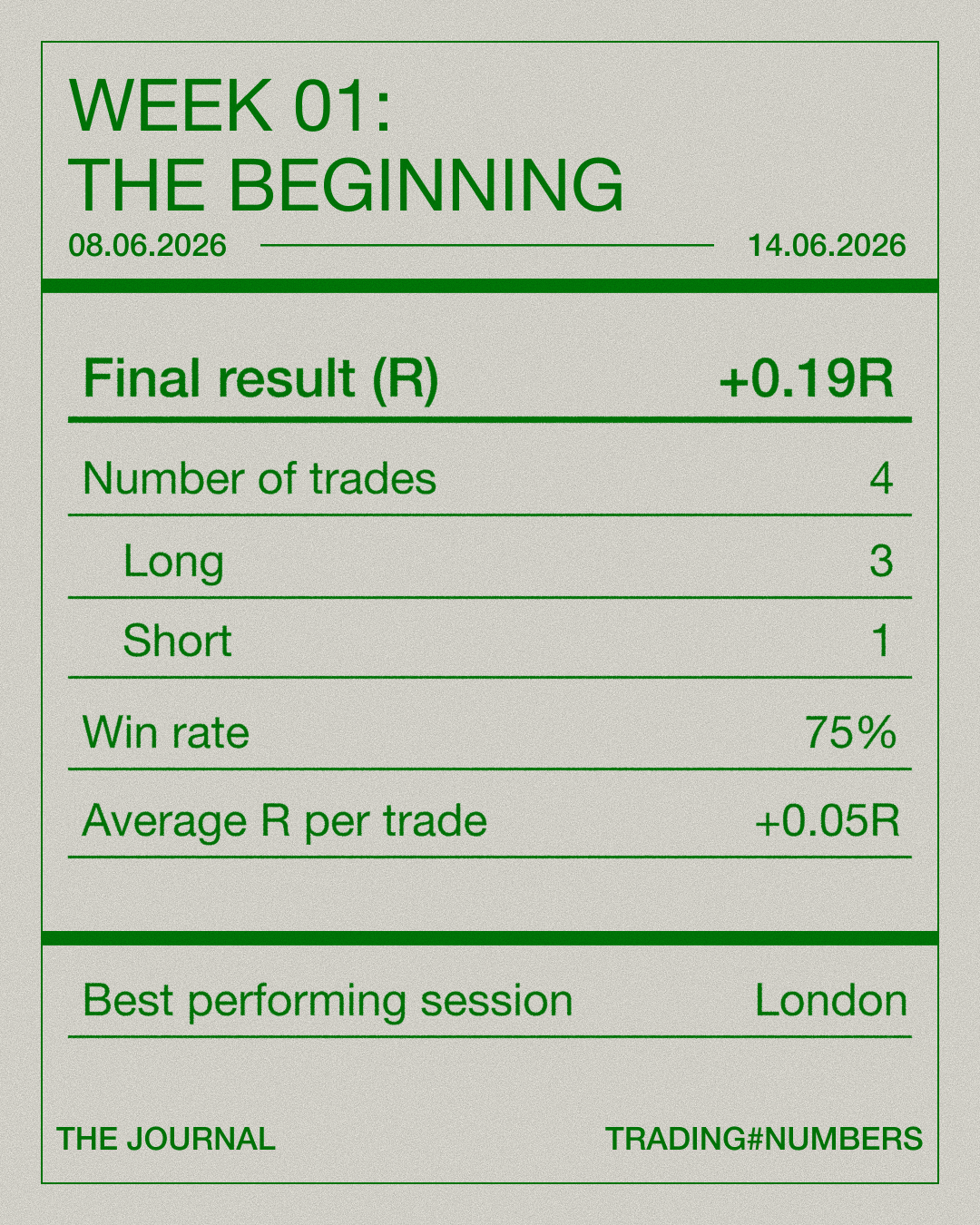
My win rate for the week was 75% but my actual result was +0.19R.
My smaller wins were all about 0.39R, but a full loser really impacted it. I lost more in a single losing trade, than I earned from two winning trades. Extrapolating on this, another full loser would mean an overall losing week. On the other hand, had I taken two more winners, then I could have taken this week’s result to nearly +1R.
The issue is the number of setups. I took 4 during the week, these were the only tradeable ones for me, so even I could get two more wins, the opportunities themselves are beyond my control.
Hey it’s a week of observations, with four trades and I’m not worried about the winners or losers at this stage. But from a purely data perspective, the expected value (EV) of my trades (win rate x average win) - (loss rate x average loss), was too thin and I can’t rely on a high win rate alone if the winners are much smaller than losers. Plus, I can’t really assume a 75% win rate is sustainable until data tells me otherwise.
So the solution is simple. Winners need to be larger.
Which brings me to the biggest takeaway of the week.
3. Exits need clear definition
This was the biggest lesson.
For one of my winning trades, I actually had a 3R target. It was logical and based on the chart it was realistic. Had I not over-managed (read: meddled) with the trade, it would have hit full profit completely. And yet I cut it at 0.39R.
I’d like to say that I had some valid reasoning for exiting this trade, and yes there was some. I saw a kind of resistance forming to the long taken. I looked at some numbers, thought something along the lines of, well it keeps rejecting here and has done so for the past 30 minutes, so I better cut it. Then I did. I secured about 10% of of the price movement I could have captured had I let it play out.
Sure it was a winner, but the exit logic was fuzzy. Actually it was ill defined. If I were to be completely honest, the other two winning trades were exited in kind of the same fashion. I could not tell you the exact rules or checklist I went through to that made me exit. This is bad. No exit strategy is a killer so this needs to be fixed.
For next week
The key weakness in my system sits in my trade exit and management so for next week:
- Experiment with closing 50% of my position at +1R and moving stops to breakeven.
- For discretionary exits, update journal entries to describe why. What was I seeing? What was new information was I processing? Was there emotion behind it?
- Start tracking Maximum Adverse Excursion (MAE) and Maximum Favourable Excursion (MFE). MAE tracks the furthest price moves against me from entry, while MFE tracks the furthest price moves in my favour before the trade is closed or starts reversing.
Basically I just need to have my exits become less random and more systematic.
Member comments