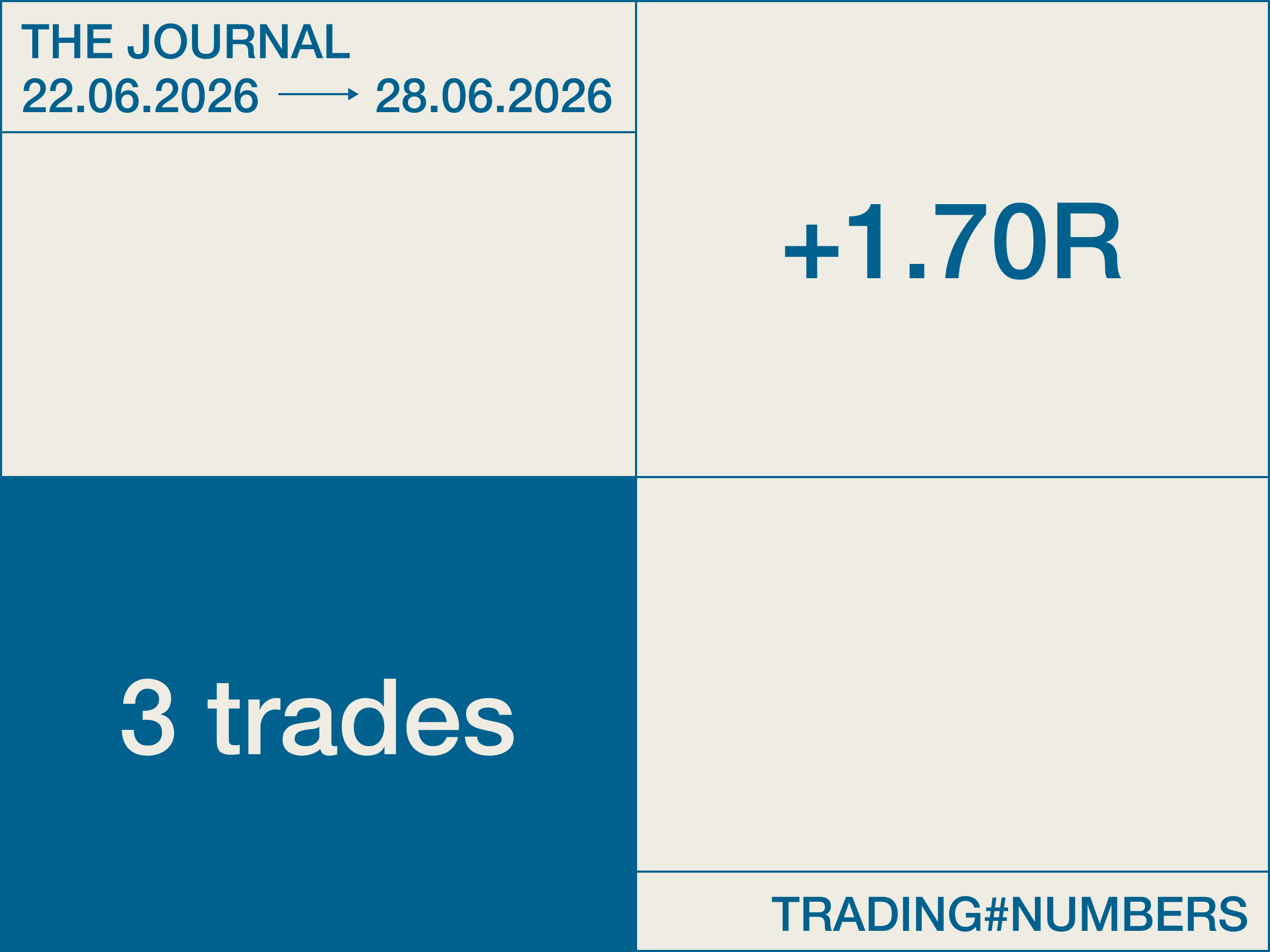
Dates
22 June 2026 to 27 June 2026
Trading Numbers
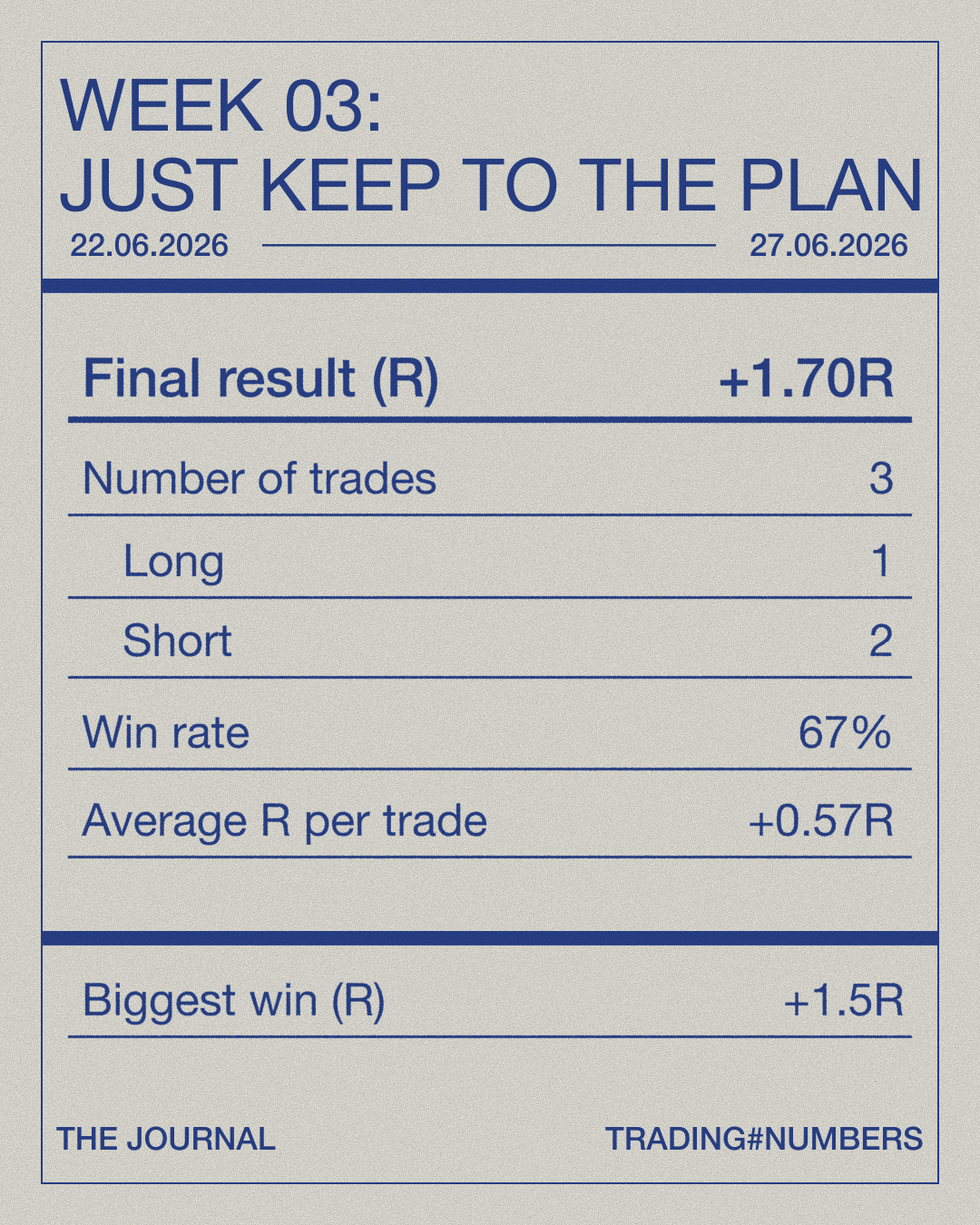
What happened
The focus on week 3 was to continue with data collection with a focus on A and A+ grade setups. Last week I took a beating (-3.2R to recap the pain) but the main lessons to address were to really take set ups at the right levels and also to properly read the orderflow with more patience.
Key takeaways
1. Stick to the basics - key levels and volume spikes
In my system, the catalyst for a trade is volume at a key level. This was a takeaway from my previous week.
So now, if price hits my level of interest with no volume, I don’t take any action unless there is truly a volume spike. If there is a volume spike, but it is not at my area of interest, then I also won’t take any trade.
In terms of the levels of interest, there was nothing too special about them at least for this week - simply marking out a range on the 15 minute time frame worked well enough.
I’m very happy to say that my trades were all taken at key levels with volume spikes, setting the scene for good trades and something basic that I just need to stick to. Simple…right?
2. Plan the trade and trade it.
I’m 10 trades in and the primary focus of all of this right now is data collection. Ultimately I need to answer the question: does my system work? Am I reading the order flow correctly? Are my levels right? Are my trade triggers valid?
Changing the thought process and therefore parameters during my trade is only going to contaminate my data set, regardless of what happens. And what this means is that eventually (well hopefully), once I start sizing up, I can’t afford to take bets based on unclean data.
So for each journal entry, I wrote down the exact hypothesis. Where my levels are, why stops were placed there and what was the invalidation.
I told myself and keep telling myself to not worry about the outcome, just the process. And again, I’m very happy to say that I stuck to it. Not only that, it’s getting easier to just let the trade go. Sure I’m still hoping the trade goes my way, but the focus has truly (and hopefully stays) flipped to be on the process itself.
3. Be careful around session opening times
I took a BTC short just before New York open. The setup was good with the right levels and orderflow data to support the decision making. All the criteria was there and originally planned for a +2.2R target. But there was a problem: New York open in 45 minutes.
Apart from my system setup, I have a trade rule: no open positions when New York opens. It’s a known liquidity event - something big enough is going to happen. There’s too much volatility and extra randomness that comes into play that really has nothing to do with my system. The only way I can cope with it for now is it not be in a trade during this time. Don’t get me wrong, New York open is a highlight of my day (yeah I know….haha).
As soon as I entered the trade, I had planned to exit 15 minutes before NY open. In that time, price had moved in my direction and come that time, I exited.
15 minutes later price absolutely dumped. Had I held, it would have been a 5R winner in a very short space of time. I winced at this, but then reassured myself that price could have equally reversed and taken me right back out. My rule did it’s job in protecting me.
For next week
The focus needs to remain on collecting clean, high-quality data as part of the system building
- Make a full trade setup checklist and take only trades that meet all criteria - no almost trades
- Continue data collection for each trade: MAE, MFE, time taken to 0.5R and 1R and post-exit MFE
- Tag and review setups that occur 30 minutes before and 30 minutes after New York open.
The additional data around time taken to certain profit milestones will help with me knowing if a trade is going my way.
I won’t take any action or change any strategies off these data points just yet. For now, I want to start moving away from relying on the ‘feel’ of whether a trade is going well to something more data-backed, which should eventually will help with trade management and exits.
I also want to explore setups and outcomes during New York opens and whether it is a period I should simply avoid, or whether there could be specific conditions that make it tradeable for me. This is particularly important and interesting given my own timezone.
Member comments