Dates
06 July 2026 to 12 July 2026
Trading Numbers
What happened
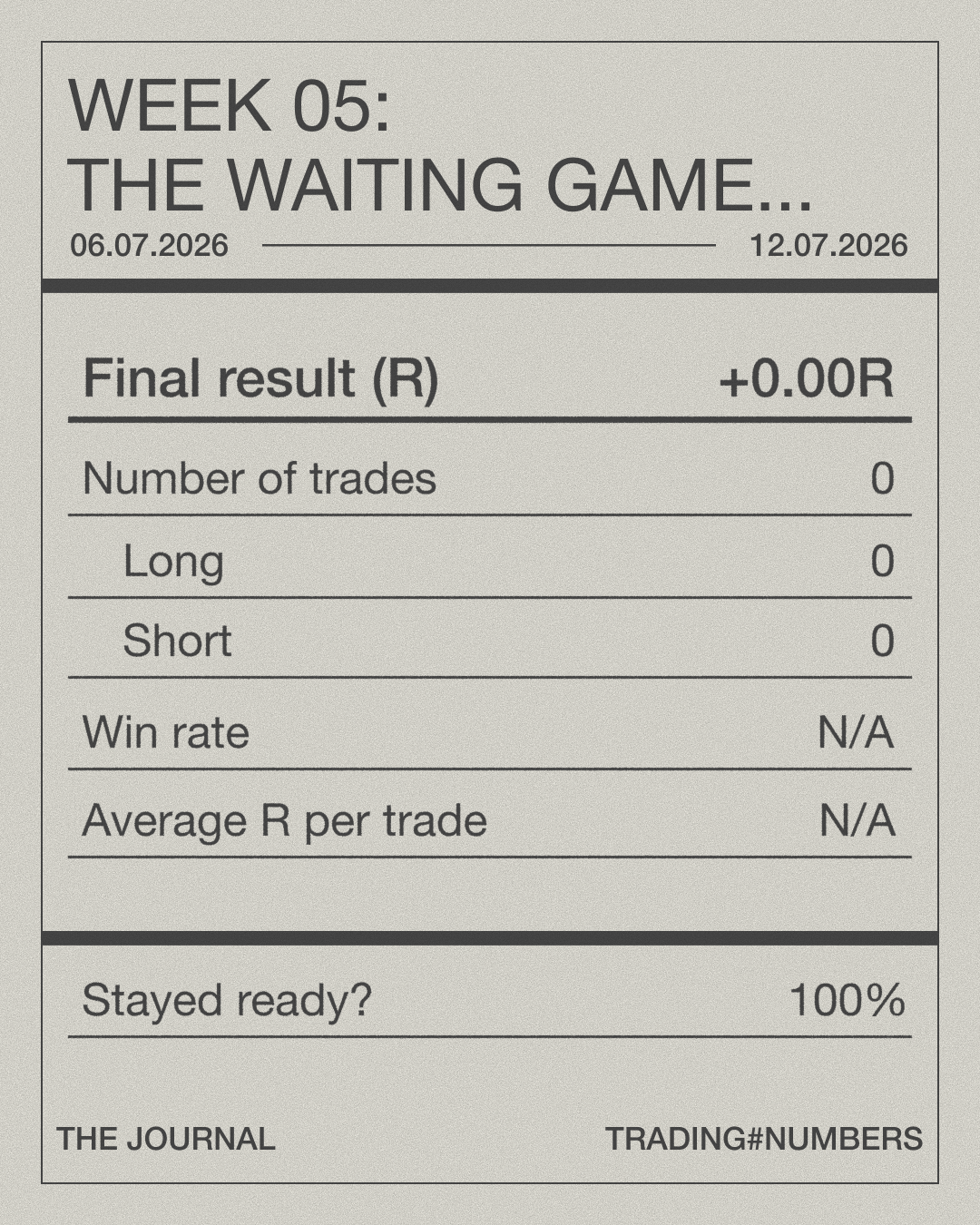
This week was all about the waiting game. While I watched and waited for my set ups to form but unfortunately this time around, there were none that I could reliably trade which resulted in zero trades. That’s right zero trades.
While the entire week was completely flat, it wasn’t for a lack of screen time. I marked out and watched my levels, set alerts, and did everything I normally would, but no opportunities arose.
While it was a little boring, there was still progress being made, and progress is always good.
On the plus side, it gave me the time to finally get this site up and running so that’s a win.
Key takeaways
1. Stick to your system
As I mentioned in last week’s entry, my system has two set ups:
- Mean reversion: When price trades in a range, moves to an extreme, over-extends, fails to breakout and rotates back into range before continuing to ping-pong.
- Trend continuation: When price trades in a range, extends to an extreme and then successfully pushes through to a new level.
The catalyst and key criteria for me to consider entering a trade is volume. I need to see a volume spike at a key level. No volume, no trade. That is a rule that cannot be broken.
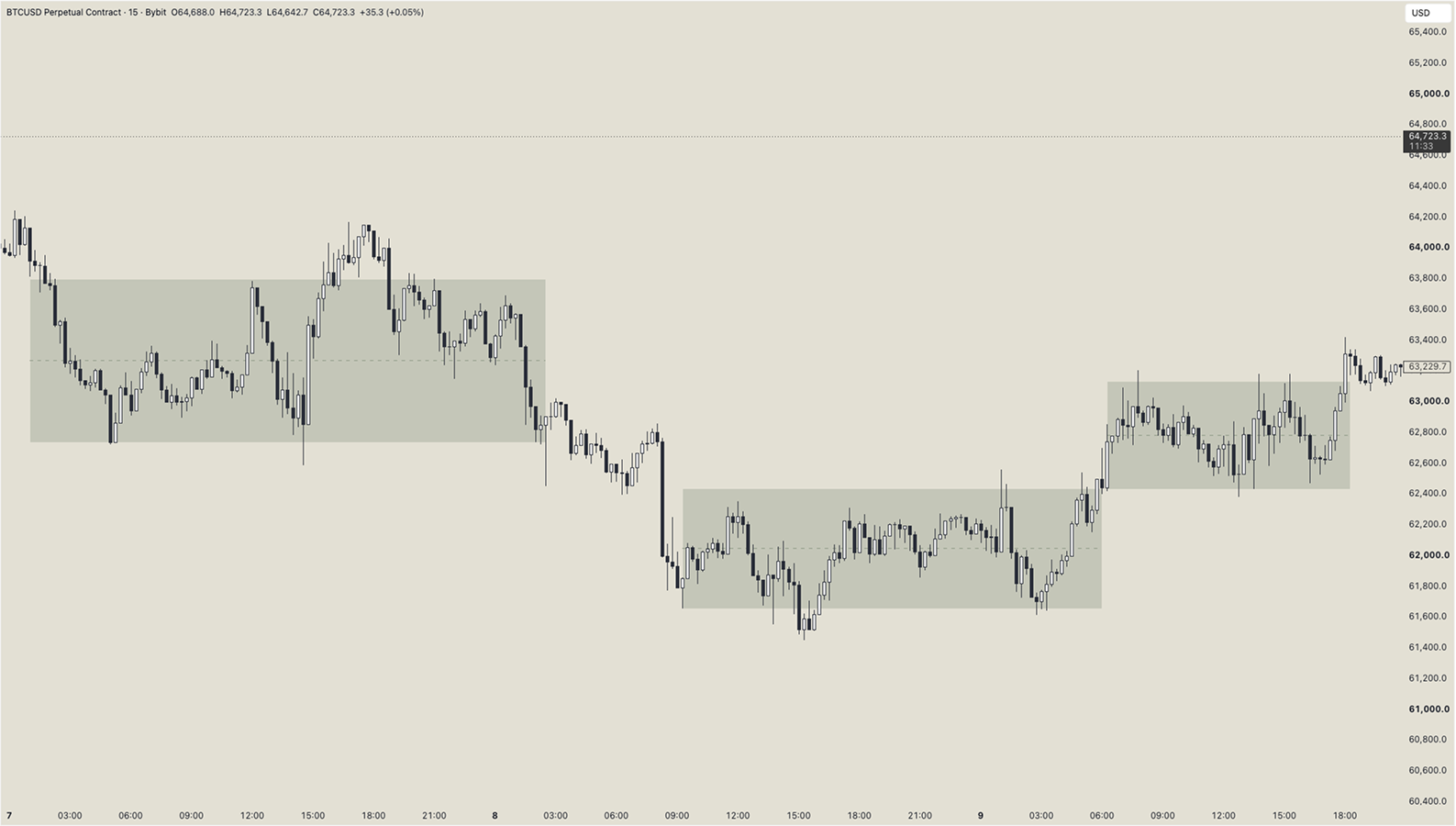
During the week, price moved and ranged at a few levels, (which is great for my system). Each time price tagged my level of interest, I saw a reaction, but there just wasn’t any volume for me. While I wanted to trade, I knew that it just wasn’t right, and while an older version of myself may have opened a position, that would have simply been a gamble and not a trade.
2. Stay alert
I’ll be honest, sitting on the sidelines wasn’t too fun, but when it comes to trading, you never know what the market is going to do.
But as a trader operating on a lower time frame, it still means staying on point, staying alert and staying ready.
Even after four days of no trades, I still made sure to mark out my levels, set alerts and watch the general price action, especially around New York open. I checked TPO levels, values areas, POCs and did everything I normally did just so that I was ready when I needed to be.
Okay, you don’t always needs to get every trade and yes, the market will always be there, but for me, my most immediate goal is to collect a good enough sample size of quality trades for my system and I want to do this as quickly as possible. I don’t want to force or rush trades, but I do want to capture them, which means doing what I’m doing.
3. Review the numbers.
Since last week I started tracking two data points (basically the same):
- Time to +/-0.5R
- Time to +/- 1R
I took a little bit of time to look at last week’s winning trades and noted:
| Trade type | Time to +0.5R | Time to +1R |
|---|---|---|
| Mean reversion | 12 minutes | 13 minutes |
| Trend continuation | 17 minutes | 26 minutes |
| Trend continuation | 15 minutes | 1 hour 50 minutes |
Sure it’s only three trades so the sample size is too small to draw conclusion, but I always had a ‘hunch’ that when I was right, I’d be onside rather quickly and measure these data points gives me something to continue testing.
I’m not changing anything just yet, but I’ll be continuing to track these numbers and seeing if any patterns arise so I can refine my system and recognise some earlier signs of strengths or weaknesses of the position.
Next week
I expect next week to have some more volatility with the release of some key economic figures, so I’ll need to continue being patient and sticking to my trading system. Other than that some things I’m looking to do:
- Explore starting a prop challenge - just varying things up a little here and putting my system into additional ‘live learning mode’. I’ll also start up a little series on this.
- Formalise my entry and exit checklist - it’s been on the to-do list
- Use TPO chart levels a little more - I’ve kind of understood this and kind of not and want to explore these a little more to see if levels are respected.
Member comments